
 RNA-guided CRISPR-Cas12a2 approach selectively kills cancer cells by targeting mutant RNA signatures
KillBait - News highlights delivered clearly and responsibly—no clickbait, no sensationalism
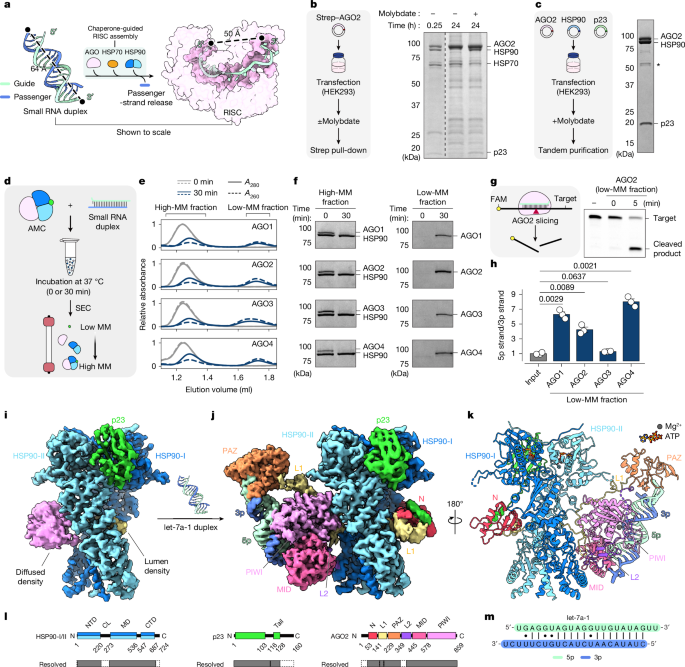
Photo: Nature
2026-06-12 05:23 Genetics 10 


Cryo-EM reveals how HSP90 chaperones guide RNA-induced silencing complex assembly
This study uncovers the structural mechanism by which the RNA-induced silencing complex (RISC), a key effector of RNA interference, is assembled in human cells.RISC is composed of an Argonaute (AGO) protein bound to a small RNA, such as a microRNA or siRNA, which guides gene silencing.
Although it has long been known that molecular chaperones like HSP70 and HSP90 are required for loading small RNA duplexes onto AGO proteins, the precise structural process remained unclear.Using cryogenic electron microscopy, the authors resolved the structure of a human AGO–HSP90–p23 complex, termed the AGO maturation complex (AMC).This complex captures AGO in an open, RNA-free conformation in which its domains are separated and stabilized by the HSP90 dimer.The arrangement exposes a positively charged cleft that allows binding of small RNA duplexes.
Importantly, the study shows that AGO folding and maturation are not driven by single-stranded RNA alone but require a double-stranded RNA duplex with a 5′ phosphate, which acts as a cofactor to promote proper structural assembly.The findings demonstrate that the chaperone system does more than stabilize proteins—it actively orchestrates AGO folding and RNA loading.The RNA duplex itself plays a previously unrecognized role as a chaperone-like element guiding protein assembly.This mechanism was validated using biochemical reconstitution experiments showing that the purified AMC can recapitulate RISC assembly in vitro.
Overall, the research provides a detailed molecular explanation for how RISC is formed and highlights the coordinated action of chaperones and RNA substrates in regulating gene silencing machinery.
These insights also have implications for improving the design of RNA-based therapeutics, such as siRNA drugs, by revealing structural requirements for efficient AGO loading.
2189
Original title: Structural basis for chaperone-guided assembly of RNA-induced silencing complex
The AI system has determined that this news is not clickbait/sensationalist: : The original title is descriptive and scientific, clearly summarizing the structural biology topic without sensational language or exaggeration. It accurately reflects the content of the research article. This has coincided with the opinion of the majority of users.
You may also be interested in...
RNA-guided CRISPR-Cas12a2 approach selectively kills cancer cells by targeting mutant RNA signatures
 Election expert criticizes MAGA push for hand-counting ballots, calling it impractical
 Jen Psaki discusses polling trends showing declining approval and voter dissatisfaction with Trump’s coalition