
 Security and AI Updates: Chinese Peptide Labs, Meta AI Hacks, and NSA Collaborations
KillBait - News highlights delivered clearly and responsibly—no clickbait, no sensationalism
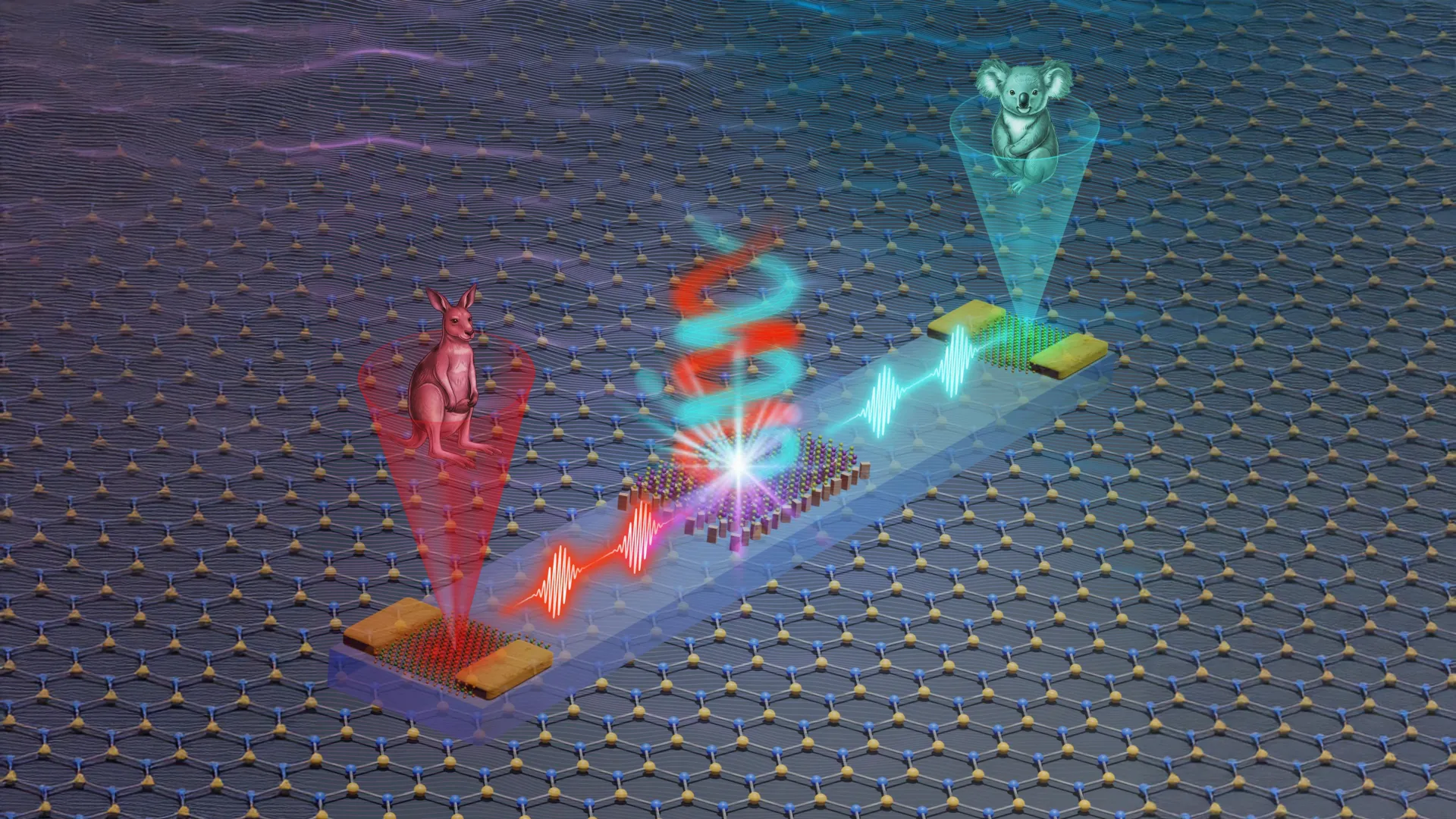
Photo: ScienceDaily
2026-06-02 19:40 Technology 24 


Integrated Valleytronics Chip Demonstrates On-Chip Generation, Routing, and Detection of Light-Based Information
Researchers at Monash University have developed a compact photonic chip capable of generating, directing, and detecting information carried by light within a single integrated device.
The breakthrough advances the field of valleytronics, which uses a quantum property known as the valley degree of freedom to encode and process information in novel ways.
Until now, scientists had been able to generate or detect valley-based signals separately, but integrating all key functions into one chip had remained a significant challenge.The new device combines atomically thin materials with engineered nanoscale metasurfaces that precisely manipulate light at extremely small scales.
According to the research team, a practical stacking method was used to integrate these materials and structures, avoiding technical difficulties associated with direct material growth.One of the technology’s major advantages is that it operates at room temperature, unlike many quantum systems that require extremely cold conditions.The researchers believe this could make future applications more practical and cost-effective.
Potential uses include faster and more energy-efficient computing systems, advanced optical communications, secure information transfer, quantum technologies, and high-performance imaging.
To demonstrate the chip’s capabilities, the team successfully encoded and processed two separate images simultaneously, showing that the platform can handle multiple streams of information at once.
Published in Nature Photonics, the study represents a step toward scalable photonic and valleytronic computing systems that rely on light rather than electrical currents to process data.
The international project involved researchers from Australia, China, Singapore, Germany, and Japan, bringing together expertise in nanophotonics, optoelectronics, and two-dimensional materials.
2377
Original title: New light-powered chip could accelerate AI and quantum computing
The AI system has determined that this news is not clickbait/sensationalist: : The title accurately reflects the research findings and uses cautious language ('could accelerate') rather than making exaggerated or unsupported claims. It summarizes the main achievement without sensationalism. This has coincided with the opinion of the majority of users.
You may also be interested in...
Security and AI Updates: Chinese Peptide Labs, Meta AI Hacks, and NSA Collaborations
 Google Enhances Pixel Voicemail with Custom Greeting Features and Smarter Controls
 Xiaomi 18 Pro rumored to feature larger 4-inch rear display with higher brightness and resolution