
 PM Shehbaz links national security with economic stability during federal budget approval meeting
KillBait - News highlights delivered clearly and responsibly—no clickbait, no sensationalism
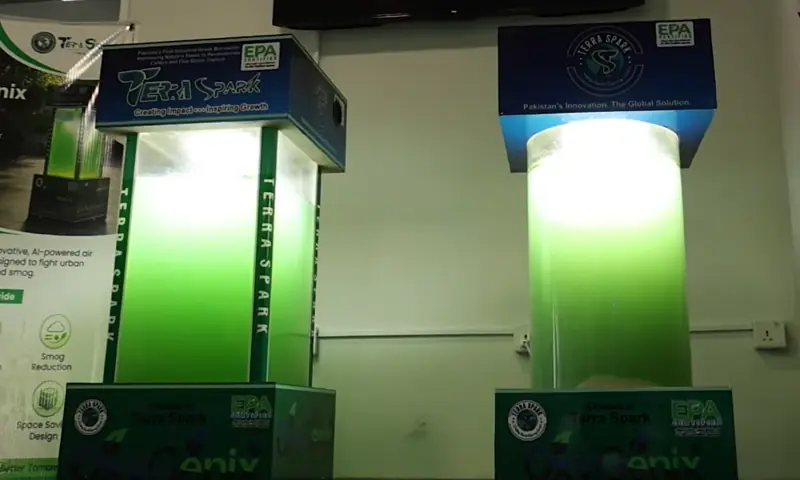
Photo: dawn.com
2026-06-15 09:41 Climate change 12 


Punjab to expand Liquid Tree initiative to improve urban air quality
The Punjab government has decided to expand its innovative Liquid Tree project as part of broader efforts to tackle rising urban pollution and smog levels through science-based environmental solutions.
The initiative is being implemented by the Punjab Environmental Protection Agency (EPA) and uses microalgae-based biotechnology designed to absorb carbon dioxide and improve air quality in densely populated urban areas where conventional tree plantation is limited.According to officials, Pakistan’s first EPA-certified Liquid Tree will be relocated from Faisalabad to Lahore under the expansion plan.
Chief Minister Maryam Nawaz stated that over 100 different types of micro-algae have been collected from regions stretching from Karachi to Khyber, which will be used to strengthen the project’s effectiveness.
In the initial phase, Liquid Trees will be installed in major shopping malls as well as indoor and outdoor public spaces to help reduce pollution exposure in urban centres.
The Chief Minister described the project as a modern scientific solution aimed at addressing increasing carbon emissions and worsening air quality in cities.
She added that artificial tree installations could complement existing environmental strategies and contribute to cleaner and healthier urban environments.Officials also highlighted that the initiative reflects Punjab’s broader shift towards technology-driven environmental management.
Alongside this project, the EPA has intensified other environmental measures, including the demolition of 36 fat-melting units, sealing of six facilities, and legal action against violators.The province has also accelerated efforts to establish plastic-free zones in major markets and announced a ban on plastic bags below 75 microns.
Furthermore, regulatory frameworks are being developed to enforce green buffer zones around industrial areas, promote mandatory plantation drives, and impose strict controls on tree cutting to reduce industrial pollution overall.
2228
Original title: Punjab expands Liquid Tree project to tackle urban pollution
The AI system has determined that this news is not clickbait/sensationalist: : The title is straightforward and accurately describes the expansion of the Liquid Tree project without exaggeration, emotional language, or sensational framing. This has coincided with the opinion of the majority of users.
You may also be interested in...
PM Shehbaz links national security with economic stability during federal budget approval meeting
 Pakistan warns India over water supply tensions, cites Indus Waters Treaty obligations
 First Hangor-class submarine PNS/M Hangor arrives in Karachi under Pakistan Navy ceremony