
 Soviet Venus Probe Survives Re-Entry After Decades in Orbit
KillBait - News highlights delivered clearly and responsibly—no clickbait, no sensationalism
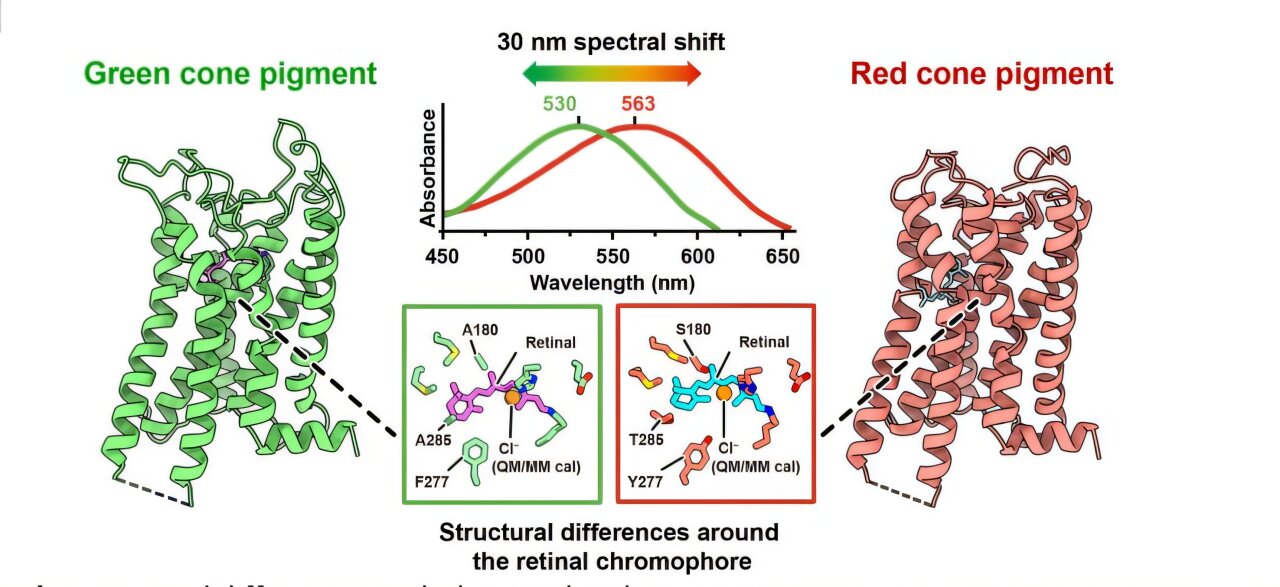
Photo: phys.org
2026-07-28 11:40 Science 10


Structural Differences in Primate Cone Pigments Reveal Mechanism for Red-Green Color Discrimination
Researchers led by Associate Professor Kota Katayama from Nagoya Institute of Technology have uncovered how subtle amino acid substitutions in primate cone pigments enable precise red-green color discrimination.
By analyzing red and green cone pigments from crab-eating macaques, whose color vision closely resembles humans', the team identified three critical amino acid changes—A180S, F277Y, and A285T—that account for the 30 nm spectral shift between the pigments.
These substitutions alter the electrostatic environment around the retinal chromophore rather than changing its geometry, allowing for distinct light absorption wavelengths.
The study, published in Science, also revealed a unique membrane-facing opening in cone pigments absent in rhodopsin, which may explain their faster regeneration rates.
These findings advance understanding of genetic variations affecting color perception and could inform drug development targeting photoreceptors and G protein-coupled receptors.
The research highlights how minute structural changes in cone pigments enable both accurate color discrimination and rapid visual function in bright light.
2187
Original title: First 3D views explain how primate cone pigments distinguish red from green
The AI system has determined that this news is not clickbait/sensationalist: : The original title uses 'First 3D views' which may attract clicks, but the study is a legitimate scientific advancement rather than sensationalist. This has coincided with the opinion of the majority of users.
You may also be interested in...
Soviet Venus Probe Survives Re-Entry After Decades in Orbit
 NASA astronaut returns to Earth after 241-day space mission with groundbreaking research contributions
 International Consortium Rescues Four Belugas from Closure of Canadian Aquarium