
 Maine Community Successfully Moved a Meeting Hall Nine Miles by Sea in 1951
KillBait - News highlights delivered clearly and responsibly—no clickbait, no sensationalism
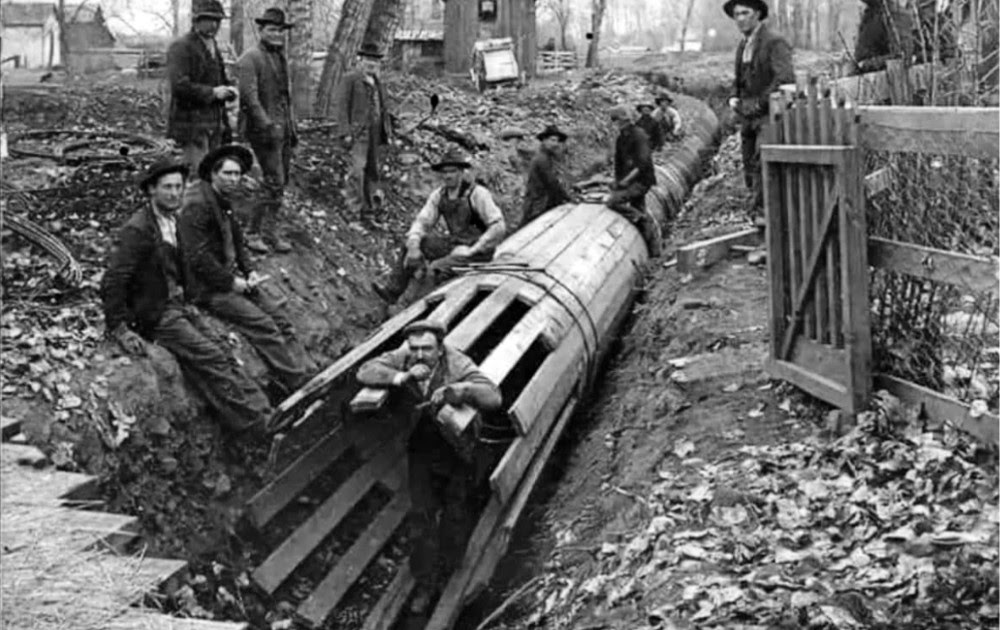
Photo: vintag.es
2026-05-25 14:17 History 17 


Historical Wooden Water Pipelines in the 19th and Early 20th Centuries
This article explores the historical use of wooden water pipelines, a once-common infrastructure solution used from the 16th century through the early 20th century across Europe and North America.
These pipelines were constructed either from hollowed-out logs or from wooden staves bound together with metal bands, providing a practical way to transport water before modern materials like cast iron became widely available and affordable.Early wooden pipes were typically made from durable woods such as elm or oak.Craftsmen would bore a hole through the center of a log using augers, creating a simple conduit for water.
The ends of these logs were shaped to interlock, forming male and female joints that tightened as the wood absorbed water and swelled, helping create a watertight seal.This made them surprisingly effective for municipal and agricultural water systems.As demand for larger water systems grew, especially in the American West, engineers developed stave-style wooden pipelines.These were constructed from multiple wooden planks arranged in a cylindrical shape and held together with iron hoops or metal bands.Additional sealing materials such as pitch or clay were often used to reduce leakage.Rot-resistant woods like cedar, redwood, fir, elm, and oak were preferred for durability.Wooden pipelines became widely used in major North American cities including Boston, Philadelphia, and Montreal during the 18th and 19th centuries.They played a crucial role in supplying water to growing urban populations and supporting agriculture and industry in expanding settlements.
However, with the rise of industrialization and the increasing availability of cast iron, wooden pipes gradually fell out of favor due to durability concerns and maintenance challenges.Some systems remained in use into the mid-20th century before being fully replaced by modern infrastructure.
2300
Original title: Historical Photos of Wooden Water Pipelines From the Late 19th and Early 20th Centuries
The AI system has determined that this news is not clickbait/sensationalist: : The original title is descriptive and informational, clearly stating the subject (historical photos of wooden water pipelines) and time period without exaggerated language or emotional manipulation. This has coincided with the opinion of the majority of users.
You may also be interested in...
Maine Community Successfully Moved a Meeting Hall Nine Miles by Sea in 1951
 The 1914 Peugeot Bébé and the Birth of the Early Affordable City Car
 Rethinking Sexuality in Prehistory: Cooperation, Social Bonds, and Evolutionary Strategy