
 Waxing Crescent Moon Visible on June 16 With 7% Illumination After the New Moon
KillBait - News highlights delivered clearly and responsibly—no clickbait, no sensationalism
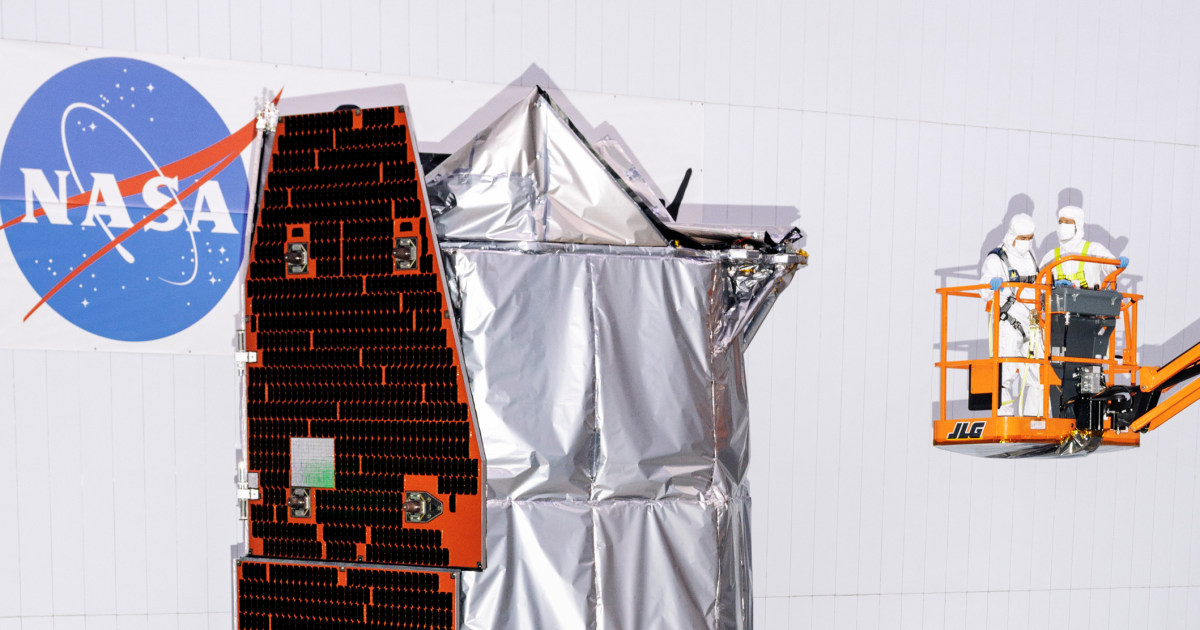
Photo: nbcnews.com
2026-06-17 04:18 Astronomy 10 


NASA’s Nancy Grace Roman Space Telescope Nears August Launch to Map the Universe and Study Dark Energy
NASA is preparing to launch its next major space observatory, the Nancy Grace Roman Space Telescope, following nearly two decades of development and an investment of about $4.3 billion.
Scheduled for a targeted launch on August 30 aboard a SpaceX Falcon Heavy rocket, the telescope represents one of NASA’s most ambitious missions in recent years.
Once deployed, it will travel to a stable orbit around the Sun-Earth Lagrange Point 2, about one million miles from Earth, where it will begin its scientific operations after an initial commissioning period.The Roman Space Telescope is designed to dramatically expand humanity’s view of the universe.
With a wide field of view, it will survey the sky at a pace estimated to be hundreds of times faster than the Hubble Space Telescope while capturing images that cover regions more than 100 times larger than Hubble’s.Over its primary mission, Roman is expected to observe hundreds of millions of stars and billions of galaxies.
Scientists anticipate it will identify more than 100,000 exoplanets and provide unprecedented data to study cosmic expansion, dark matter, and dark energy.
The mission includes three primary surveys: a deep study of the Milky Way’s galactic bulge, a wide-area sky survey covering roughly 12% of the sky, and a long-term supernova observation program that will help trace the universe’s expansion history.These datasets will allow astronomers to build the most detailed cosmic maps ever created.
Named after pioneering NASA astronomer Nancy Grace Roman, the telescope is also intended to work in coordination with the Hubble and James Webb Space Telescopes, enhancing discoveries by providing wide-field context for deeper observations.If successful, its first images could be released by the end of 2026, marking a new era in space-based astronomy.
2186
Original title: 1,000 times faster than Hubble: Up close with the NASA space telescope meant to unlock the cosmos
The AI system has determined that this news is clickbait/sensationalist: : The original title uses a highly sensational comparison (“1,000 times faster than Hubble”) which is attention-grabbing and somewhat clickbait-like, even though it is based on a real performance claim. This has coincided with the opinion of the majority of users.
You may also be interested in...
Waxing Crescent Moon Visible on June 16 With 7% Illumination After the New Moon
 Japan Successfully Launches the First H3-30 Rocket Variant on Test Mission Carrying Six Small Satellites
 Space-Qualified 6 mm Metasurface Lens Demonstrates Satellite-Level Solar Magnetic Field Measurements